
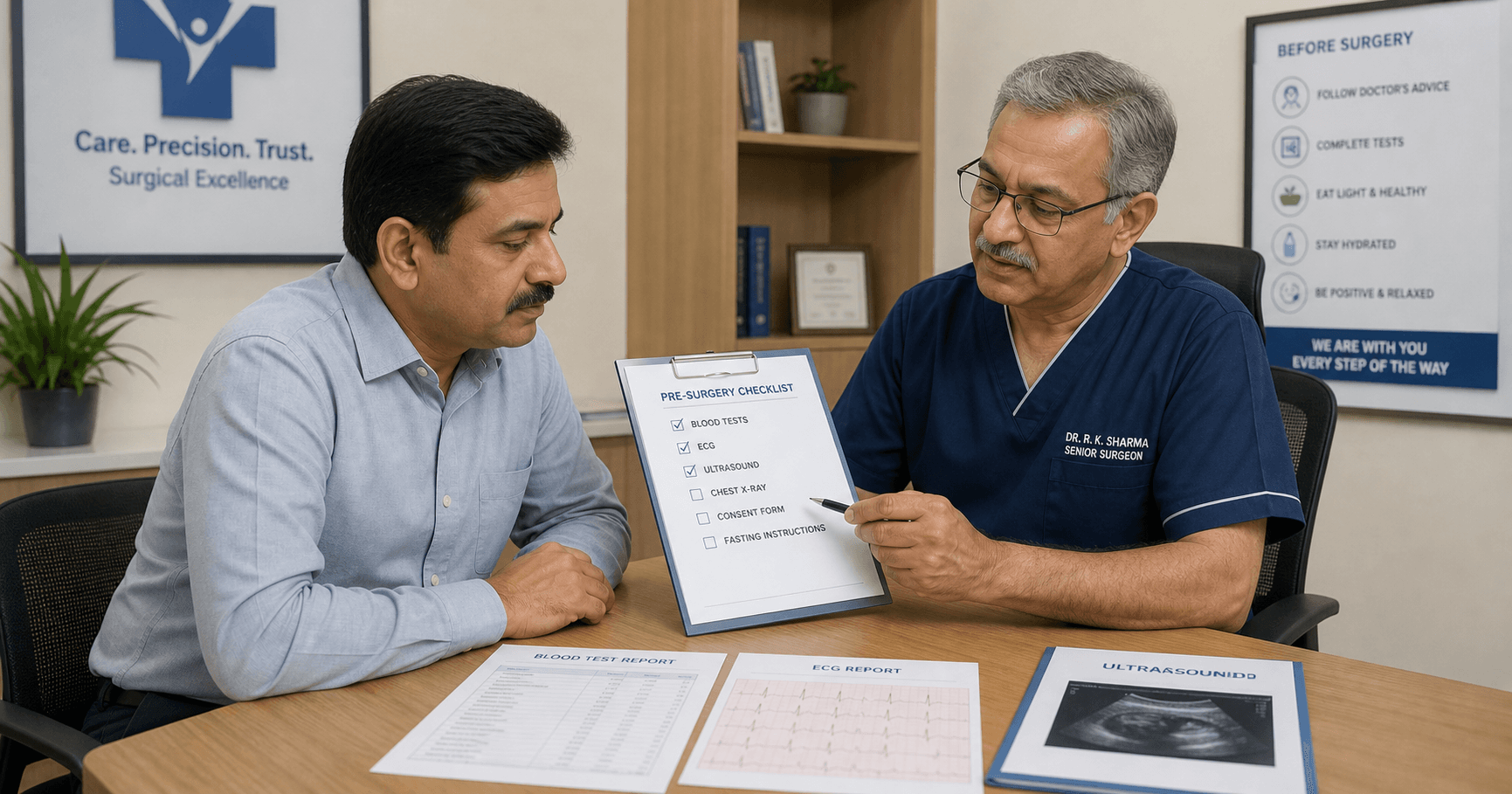
Which pre-surgery tests are usually checked before laparoscopic surgery?
Before laparoscopic surgery, patients commonly need a clinical examination, diagnosis-confirming reports, basic blood tests, anesthesia fitness review and condition-specific imaging. The exact tests are selected by the surgeon and anesthesia team after reviewing the operation, symptoms and medical risk.
Pre-surgery tests are investigations and medical reviews used to confirm the diagnosis, estimate anesthesia risk, plan the safest operation and identify problems that should be corrected before admission. They are not meant to be a random package copied from another patient.
Fast decision rule: if you are planning surgery, carry every recent report and a written medicine list first. Then ask which tests are essential for your operation, which are optional, which need repeating, and who will review the final fitness before admission. For the broader pre-op visit, use /articles/pre-op-appointment-before-surgery-bhopal to connect test results with medicines, consent, admission timing and warning signs.
Why are tests different for gallbladder, hernia, appendix and bariatric surgery?
The test list changes because each operation asks a different safety question. Gallbladder surgery may need ultrasound and liver-related review. Hernia surgery may focus on the swelling, previous repair and fitness for anesthesia. Appendix surgery can become urgent. Bariatric surgery usually needs broader metabolic and nutrition assessment.
This is why a generic "all surgery tests" list can mislead patients. A young patient with a small planned hernia repair may not need the same workup as an older patient with diabetes, blood thinners and gallbladder inflammation.
For Bhopal patients, a practical path is to consult with the ultrasound, CT if done, old prescriptions, diabetes and BP records, previous discharge summaries and current symptoms. Dr. Rajesh Kanungo can then explain whether the plan fits laparoscopic surgery, open surgery, observation or urgent review.
What should you carry for the pre-surgery consultation?
Carry the latest ultrasound, CT, MRI or endoscopy report if relevant, blood tests, ECG or heart reports, old discharge summaries, previous operation notes, allergy history, diabetes and BP records, and a written list of all prescription, over-the-counter, herbal and supplement medicines.
MedlinePlus day-of-surgery guidance says the care team may review health history, medicines, anesthesia, questions, and whether the patient is sick before surgery: https://medlineplus.gov/ency/patientinstructions/000578.htm. This supports a simple rule: complete information is safer than memory-based answers.
Useful medicine checklist: blood thinners, aspirin or pain medicines, diabetes tablets or insulin, BP tablets, thyroid medicine, steroid use, inhalers, weight-loss injections, supplements, tobacco, alcohol and any previous anesthesia problem. If you use an NSAID, /articles/ibuprofen-before-surgery-bhopal explains what details to report. Do not stop regular medicines on your own without instruction from the responsible doctor.
When is anesthesia fitness or surgical clearance needed?
Anesthesia fitness is needed when the operation requires anesthesia or sedation, and it becomes especially important when a patient has diabetes, high BP, heart disease, lung disease, kidney disease, sleep apnea, obesity, anemia, blood thinners, older age or previous anesthesia problems.
Anesthesia is the use of medicines to prevent pain during surgery or procedures. MedlinePlus explains anesthesia at https://medlineplus.gov/anesthesia.html, and the American Society of Anesthesiologists patient checklist emphasizes sharing health details, medicines and anesthesia concerns before surgery: https://madeforthismoment.asahq.org/preparing-for-surgery/prep/preparing-for-surgery-checklist/.
Surgical clearance is not a guarantee that nothing can go wrong. It is a risk review. The safer question is: what risk was found, what needs optimization, which medicine instructions apply, and should surgery proceed now or after another physician review?
Which questions should patients ask about blood tests, ECG and imaging?
Ask why each test is being ordered, whether it changes the surgery plan, when it should be done, whether old reports are still useful, and what result would delay admission. This turns testing from a confusing bill into a decision tool.
Decision checklist: What diagnosis does the imaging confirm? Are CBC, blood sugar, kidney function, liver function or coagulation tests needed for my case? Is ECG enough or is physician or cardiology review needed? Do I need repeat ultrasound or CT? Are infection markers or urine tests relevant? Who signs final fitness?
If a result is abnormal, avoid self-interpreting it online. A mild abnormality may only need context, while a significant or worsening result may change timing or require another specialist opinion. The surgeon and anesthesia team should connect the result to your actual operation.
How should medicines, fasting and illness be handled before surgery?
Medicine and fasting instructions should come from the treating team because risk changes by operation, anesthesia type and medical history. Patients should specifically ask about blood thinners, diabetes medicines, BP medicines, painkillers, supplements, inhalers and what to do if fever, cough or infection appears before admission. Patients with hypertension can use /articles/high-blood-pressure-before-surgery-bhopal to prepare BP records and medicine questions before the anesthesia review.
MedlinePlus night-before-surgery guidance discusses medicines such as blood thinners and tells patients to take only medicines the doctor instructed with a small sip of water: https://medlineplus.gov/ency/patientinstructions/000371.htm. The same source warns against eating or drinking after the instructed time before surgery.
Do not create your own fasting or medicine plan. If instructions conflict, call the hospital before admission. This matters for patients with diabetes, heart disease, kidney disease, blood thinners, acid reflux, pregnancy possibility, sleep apnea or prior anesthesia complications.
Which warning signs should not wait for a planned surgery date?
Do not wait for a planned surgery date if the patient has severe or worsening abdominal pain, repeated vomiting, fever, yellow eyes, fainting, breathing difficulty, chest pain, confusion, uncontrolled sugar or BP symptoms, a painful stuck hernia bulge, or any patient who looks very unwell.
The CDC lists surgical site infection warning signs such as redness and pain around the operated area, cloudy wound fluid and fever: https://www.cdc.gov/surgical-site-infections/about/index.html. Before surgery, fever, worsening pain, cough, chest symptoms or skin infection should also be reported because they may change timing or safety.
This article is patient education, not diagnosis or treatment advice. For severe, sudden or worsening symptoms, call the treating doctor or go to emergency care first. For planned review in Bhopal, bring reports to Dr. Rajesh Kanungo at R.K. Hospital, Indrapuri.
How do you leave the consultation with a clear next step?
A good pre-surgery visit should end with the diagnosis, planned operation or alternative, required tests, medicine instructions, anesthesia fitness step, admission plan, expected recovery limits, emergency warning signs and follow-up contact route.
Before leaving, ask for the shortest possible plan in writing: tests to complete, reports to bring back, medicines to continue or review, fasting instruction timing, likely admission date, estimated stay, work and lifting restrictions, and whom to call if symptoms worsen before surgery.
If you want a consultation script, use the question checklist at /articles/questions-to-ask-before-laparoscopic-surgery-bhopal before your next visit so diagnosis, anesthesia, medicines, cost factors and warning signs are all discussed clearly.
The goal is not to collect the maximum number of tests. The goal is to reduce uncertainty before an operation and avoid preventable surprises on admission day.
Which medical sources support this checklist?
This guide was cross-checked against MedlinePlus day-of-surgery guidance at https://medlineplus.gov/ency/patientinstructions/000578.htm, MedlinePlus night-before-surgery guidance at https://medlineplus.gov/ency/patientinstructions/000371.htm, MedlinePlus anesthesia information at https://medlineplus.gov/anesthesia.html, the American Society of Anesthesiologists patient preparation checklist at https://madeforthismoment.asahq.org/preparing-for-surgery/prep/preparing-for-surgery-checklist/, and CDC surgical site infection basics at https://www.cdc.gov/surgical-site-infections/about/index.html.
These sources support the same practical message: share complete medical and medicine information, follow fasting and medicine instructions from the treating team, ask questions before the operation day, and seek prompt care for fever, breathing symptoms, severe pain, wound changes or a very unwell patient.
Related care options
More patient guides
Types of Abdominal Hernias: A Location Guide for Bhopal Patients
Abdominal hernias are named mainly by where tissue pushes through a weak area: the groin, upper thigh, navel, upper midline, abdominal wall or an old surgical scar. Location is a useful clue, but examination—not a photo or symptom list—is what separates a hernia from other lumps and guides safe treatment.
Can You Live Without a Gallbladder? What Changes After Surgery
Yes. Most people can live a normal life without a gallbladder because the liver keeps making bile. After removal, bile flows directly into the small intestine instead of being stored. Some people notice temporary digestive changes, but persistent or severe symptoms deserve medical review.
Nail Polish Before Surgery: What Should Patients Remove?
Many hospitals ask patients to remove nail polish, gel or false nails before surgery because staff may need access to a natural nail for monitoring and assessment. The safest shortcut is simple: ask the hospital in advance, follow its written instruction, and tell the team if a product or item cannot be removed safely.
Common questions
No. Tests depend on the planned operation, age, symptoms, medical history, medicines, previous surgery, anesthesia risk and whether the surgery is planned or urgent.
Sometimes old reports help, but the surgeon or anesthesia team decides whether they are recent enough and relevant. Carry old reports, but ask which tests need repeating before admission.
Do not stop them yourself. Tell the surgeon and anesthesia team exactly what you take, then follow the specific instruction from the responsible doctor about stopping, changing or restarting medicines.
Seek urgent medical help for severe worsening pain, repeated vomiting, fever, jaundice, chest pain, breathing difficulty, fainting, confusion, a stuck painful hernia bulge or any patient who looks very unwell.