
Can a hernia belt help an inguinal hernia?
A hernia belt may help some patients feel temporary support when an inguinal hernia is small, soft and reducible, but it does not close the hernia opening. It should be discussed with a surgeon or healthcare professional, especially if pain, growth or work limitations are present.
An inguinal hernia is a bulge in the groin area caused by tissue pushing through a weak spot in the lower abdominal wall. Patients often notice it more while standing, coughing, straining or lifting, and it may reduce when lying down.
Fast decision rule: a belt can be a support question for a stable, reducible swelling; it is not the answer for a painful, stuck, red, dark, vomiting-associated or fever-associated swelling. Those symptoms should go to urgent medical care first.
When is a hernia belt not enough?
A hernia belt is not enough when the swelling is getting larger, becoming painful, no longer reducing, affecting walking or work, or repeatedly returning despite support. It is also not enough when the diagnosis is uncertain or the swelling may be something other than an inguinal hernia.
Mayo Clinic notes that a supportive truss may sometimes help relieve symptoms, but a health professional should check fit and appropriate use: https://www.mayoclinic.org/diseases-conditions/inguinal-hernia/diagnosis-treatment/drc-20351553. NHS England patient decision support also describes using a binder or truss while lying down and when the hernia is reduced: https://www.england.nhs.uk/wp-content/uploads/2023/11/PRN00250-dst-making-a-decision-about-inguinal-hernia.pdf.
The practical point is simple: support is not the same as repair. If the hernia is confirmed and symptoms continue, a surgeon can explain observation, open repair, laparoscopic repair, mesh discussion, anesthesia fitness and timing. Patients comparing belt support with repair can also read /articles/hernia-mesh-repair-bhopal before writing their consultation questions.
What warning signs should override belt use?
Do not use a belt to delay care if the bulge becomes very painful, stuck, red, purple, dark, hot or tender, or if there is vomiting, fever, abdominal swelling, constipation, inability to pass gas, faintness or a very unwell feeling. These can be emergency warning signs.
NIDDK explains that inguinal hernias can become stuck or strangulated and need immediate medical care when symptoms such as sudden pain, nausea, vomiting, fever, color change or inability to pass gas or stool appear: https://www.niddk.nih.gov/health-information/digestive-diseases/inguinal-hernia. Mayo Clinic lists similar warning signs for a strangulated hernia: https://www.mayoclinic.org/diseases-conditions/inguinal-hernia/symptoms-causes/syc-20351547.
If these symptoms occur, call the surgeon, go to emergency care or use local emergency services. Do not eat a heavy meal, repeatedly press the swelling, take repeated painkillers to push through the day, or wait for a routine OPD slot. For a sharper red-flag list, read /articles/strangulated-hernia-symptoms-bhopal.
How should you discuss belt use with a surgeon?
The useful consultation question is not "Which belt should I buy?" but "Is my hernia reducible, low-risk enough for temporary support, or should repair be planned?" The answer depends on examination, symptoms, occupation, medical fitness, previous surgery and whether the hernia is one-sided, both-sided or recurrent.
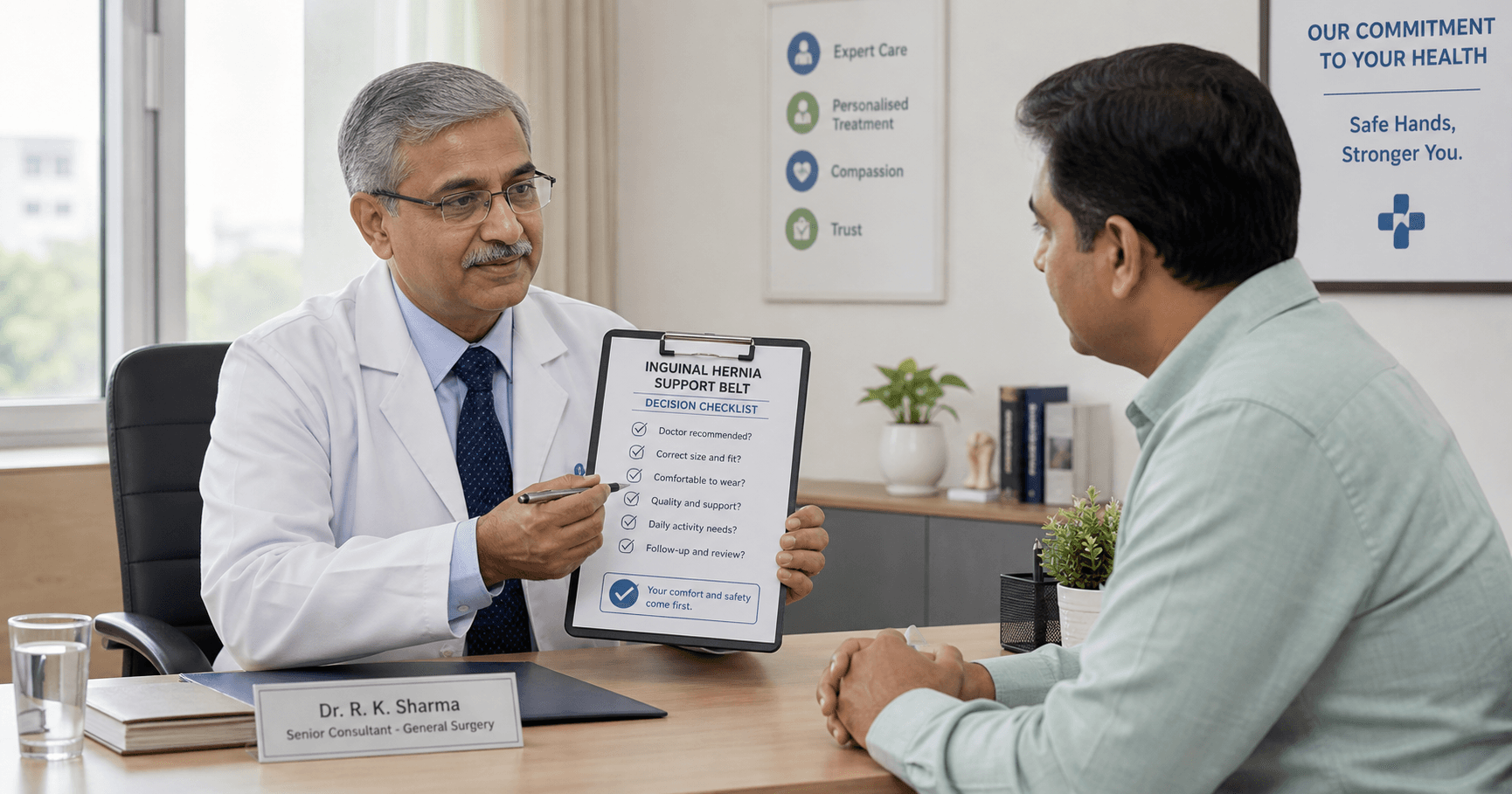
Decision checklist: small and soft swelling that reduces when lying down may allow planned review; discomfort during standing or work needs surgeon discussion; growing swelling needs earlier planning; severe pain, vomiting, fever, color change or stuck swelling needs urgent care.
For Bhopal patients, Dr. Rajesh Kanungo evaluates inguinal, umbilical and abdominal wall hernias at R.K. Hospital, Indrapuri. Bring any ultrasound or CT report, previous prescriptions and notes about when the swelling appears. The inguinal hernia symptoms in men guide can help men write that timeline before buying a support belt, while /articles/hernia-symptoms-in-women-bhopal covers female hernia symptoms that may be more subtle.
Can a belt replace hernia surgery?
A belt cannot usually replace hernia surgery when a true hernia needs repair. It may reduce symptoms temporarily in selected patients, but the abdominal wall defect remains and should be reviewed over time.
SAGES patient information explains that inguinal hernia repair may be open, laparoscopic or robotic, often using mesh, and that the choice depends on the individual patient and surgeon assessment: https://www.sages.org/publications/patient-information/inguinal-hernia-repair-surgery-sages-patient-information/. MedlinePlus also describes hernia repair as surgery to correct a hernia: https://medlineplus.gov/hernia.html. For mesh-specific patient questions, see /articles/hernia-mesh-repair-bhopal.
The best use of a belt question is to reduce effort while you get clarity: confirm the diagnosis, understand urgency, ask whether repair should be planned, and know exactly which symptoms should make you go to hospital. If you are hoping the opening will close by itself, /articles/can-hernia-heal-without-surgery-bhopal explains what watchful waiting can and cannot do.
What should you carry for a hernia belt or surgery consultation?
Carry previous ultrasound or CT reports if done, old discharge summaries, medicine list, blood thinner details, diabetes and BP records, allergy history, previous hernia repair notes and a written symptom timeline.
Helpful notes include: where the bulge appears, whether it reaches the scrotum, whether it reduces while lying down, what work or lifting makes it worse, whether cough or constipation is present, whether pain is increasing, and whether vomiting or fever has happened.
Reduce time in the visit by writing three questions before you arrive: is this definitely an inguinal hernia, is temporary support reasonable for me, and what would make repair urgent or planned?
Which medical sources support this guidance?
This article is patient education, not a diagnosis, prescription, product recommendation, emergency triage tool or replacement for examination. It was cross-checked against NIDDK inguinal hernia guidance at https://www.niddk.nih.gov/health-information/digestive-diseases/inguinal-hernia, Mayo Clinic inguinal hernia symptoms and treatment guidance at https://www.mayoclinic.org/diseases-conditions/inguinal-hernia/symptoms-causes/syc-20351547 and https://www.mayoclinic.org/diseases-conditions/inguinal-hernia/diagnosis-treatment/drc-20351553, NHS England inguinal hernia decision support at https://www.england.nhs.uk/wp-content/uploads/2023/11/PRN00250-dst-making-a-decision-about-inguinal-hernia.pdf, MedlinePlus hernia information at https://medlineplus.gov/hernia.html, and SAGES patient information on inguinal hernia repair at https://www.sages.org/publications/patient-information/inguinal-hernia-repair-surgery-sages-patient-information/.
These sources support the same safety message: belts or trusses may have a limited supportive role in selected reducible hernias, but warning signs such as severe pain, vomiting, fever, color change or a stuck bulge should not wait.
Related care options
More patient guides
Types of Abdominal Hernias: A Location Guide for Bhopal Patients
Abdominal hernias are named mainly by where tissue pushes through a weak area: the groin, upper thigh, navel, upper midline, abdominal wall or an old surgical scar. Location is a useful clue, but examination—not a photo or symptom list—is what separates a hernia from other lumps and guides safe treatment.
Can You Live Without a Gallbladder? What Changes After Surgery
Yes. Most people can live a normal life without a gallbladder because the liver keeps making bile. After removal, bile flows directly into the small intestine instead of being stored. Some people notice temporary digestive changes, but persistent or severe symptoms deserve medical review.
Nail Polish Before Surgery: What Should Patients Remove?
Many hospitals ask patients to remove nail polish, gel or false nails before surgery because staff may need access to a natural nail for monitoring and assessment. The safest shortcut is simple: ask the hospital in advance, follow its written instruction, and tell the team if a product or item cannot be removed safely.
Common questions
It may be safe for selected patients when the hernia is reducible and the belt is fitted and used appropriately. It should be discussed with a healthcare professional, especially if pain, growth or work limitations are present.
No. A belt may support the bulge temporarily, but it does not close the abdominal wall defect. A surgeon should review whether observation, planned repair or urgent care is appropriate.
Seek urgent medical help for a painful stuck bulge, vomiting, fever, redness, purple or dark color, abdominal swelling, constipation, inability to pass gas, faintness or a very unwell patient.
A general and laparoscopic surgeon can examine the groin swelling, confirm whether it is an inguinal hernia, assess whether temporary support is reasonable, and explain open or laparoscopic repair options.