
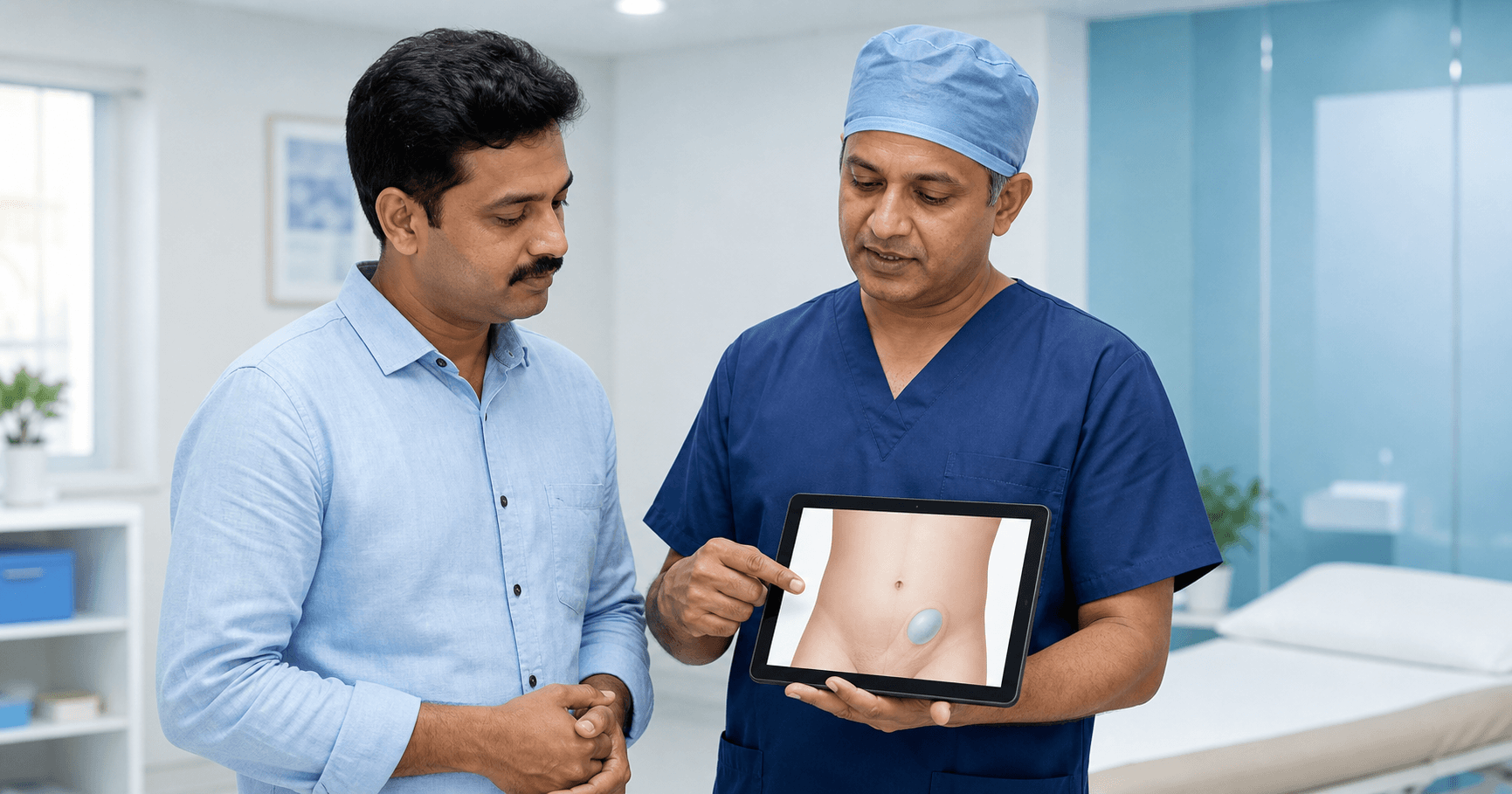
Is swelling normal after hernia surgery?
Some swelling, bruising and firmness around a hernia repair can occur during early healing. A soft fluid swelling called a seroma may also form where the hernia sac or tissue space was. However, a photo or symptom description cannot prove that a lump is harmless; the operating team should review swelling that is new, enlarging, painful or worrying.
A seroma is a collection of clear fluid beneath the skin or in a space created during surgery. It is different from pus, blood and a recurrent hernia, although patients may describe all four as a “bulge.” Examination—and sometimes ultrasound—is what separates them.
Fast decision rule: note whether the swelling is getting smaller or larger, soft or tense, mildly sore or increasingly painful, and whether fever, redness, discharge, vomiting or inability to pass stool or gas is present. A worsening trend or any warning sign deserves prompt contact.
Why can a seroma form after hernia repair?
A seroma can form when small blood and lymph vessels release fluid into the space left after tissue has been moved or a hernia sac has been reduced. Larger hernias and wider tissue spaces may make a noticeable fluid pocket more likely, but only the treating surgeon can interpret a particular swelling.
Cleveland Clinic describes a seroma as a fluid-filled lump that can occur after surgery and notes that many small seromas resolve as the body reabsorbs the fluid: https://my.clevelandclinic.org/health/diseases/seroma. StatPearls also describes seroma as a postoperative fluid collection that can cause swelling and discomfort: https://www.ncbi.nlm.nih.gov/books/NBK585101/.
A seroma does not automatically mean the mesh moved or the hernia returned. Equally, patients should not label every bulge a seroma and ignore it. Timing, examination, wound appearance and the surgeon’s knowledge of the operation matter.
How can patients describe the swelling clearly?
Tell the surgeon when the swelling first appeared, whether it changes while standing or lying down, whether coughing changes it, whether it is growing, and whether the skin is red, warm, dark or leaking. Also report pain trend, temperature, appetite, vomiting, urination, stool and gas.
Simple comparison checklist: a seroma may feel soft or fluid-like and appear during early healing; bruising can add blue or purple skin; infection concern rises with spreading redness, warmth, pus-like drainage, fever or worsening pain; recurrence may become more obvious with standing or coughing. These patterns overlap and are not a home diagnosis.
Take one dated photo only if the operating team asks or the swelling changes between visits. Do not press repeatedly, puncture it, massage it aggressively, wear an unapproved tight binder or delay a review while collecting photos.
When should swelling after hernia surgery be urgent?
Seek urgent medical assessment for rapidly increasing swelling, severe or worsening pain, active bleeding, wound opening, spreading redness, pus-like drainage, fever, repeated vomiting, increasing abdominal bloating, inability to pass stool or gas, fainting, confusion, chest pain, breathlessness or a patient who looks very unwell.
The CDC lists redness and pain around the surgical area, cloudy drainage and fever among surgical-site infection signs: https://www.cdc.gov/surgical-site-infections/about/index.html. NIDDK advises immediate care for a hernia bulge that no longer reduces or is associated with sudden severe pain, fever, redness, nausea, vomiting, bloating or obstruction symptoms: https://www.niddk.nih.gov/health-information/digestive-diseases/inguinal-hernia.
Emergency rule: severe symptoms should go to the nearest emergency department or local emergency services rather than wait for an online answer or routine appointment. Do not force a painful bulge back. For focused danger signs, read /articles/strangulated-hernia-symptoms-bhopal.
Does a postoperative bulge mean the hernia has returned?
No. A bulge after repair may be normal tissue swelling, a seroma, a collection of blood, scar tissue, infection or recurrence. Early postoperative appearance alone cannot reliably identify the cause, and a persistent or returning cough-related bulge still needs examination.
A useful timeline question is whether the lump appeared immediately after surgery and is shrinking, or appeared later and becomes more prominent with standing, coughing or straining. Even that distinction is only a clue. The surgeon may decide that examination is enough or may request ultrasound or other imaging.
If the concern is months or years after repair, use the /articles/recurrent-hernia-after-surgery-bhopal review checklist and bring the old discharge summary, operation note and mesh details if available.
Should a seroma be drained?
Not every seroma needs drainage. Small, uncomplicated collections may be observed because the body can reabsorb fluid. A larger, painful, persistent or uncertain collection may need surgeon review and sometimes aspiration or another procedure. That decision must account for infection risk, mesh, symptoms and examination.
Do not insert a needle, squeeze the wound or ask an untrained person to drain it. The American College of Surgeons advises patients after hernia repair to follow wound instructions and contact the surgeon for concerns such as increasing pain, swelling, redness, drainage or fever: https://www.facs.org/for-patients/the-day-of-your-surgery/hernia-repair/.
If observation is advised, ask for a concrete plan: what change should occur, when the next review is, whether a dressing or support is recommended, what activity limits apply, and which symptoms mean call the same day.
What should you do while waiting for the surgeon to review it?
Follow the discharge instructions, keep the wound clean and dry as directed, take only prescribed or approved medicines, avoid unapproved pressure or massage, and stay within the lifting and activity limits given by the surgeon. Call before changing dressings, restarting gym activity or using a belt.
Record four facts once or twice daily rather than checking constantly: approximate size, pain score, skin or wound change, and temperature if feverish. Also note vomiting, bowel function and whether the swelling changes with posture. This gives the clinician a useful trend without turning observation into self-treatment.
For broader walking, work and lifting questions, read /articles/hernia-surgery-recovery-time-bhopal. If mesh questions are causing anxiety, /articles/hernia-mesh-repair-bhopal explains what to ask at review.
What should Bhopal patients bring to the follow-up visit?
Bring the discharge summary, operation note if supplied, medicine list, dressing instructions, temperature record, symptom timeline and any requested photographs. Mention diabetes, smoking, blood thinners, cough, constipation and physical work because each can affect recovery planning.
Ask direct questions: does this look like expected healing, seroma, bruising, infection or recurrence; is imaging needed; should it be observed or treated; what should change before the next review; and which symptom means the hospital should be called immediately?
For a diagnosis-first postoperative review in Bhopal, contact the operating hospital or book a consultation with Dr. Rajesh Kanungo at R.K. Hospital, Indrapuri. This article is general patient education, not diagnosis, prescription advice or a replacement for the surgeon who knows the operation.
Which medical sources support this guide?
This guide was cross-checked against Cleveland Clinic seroma information at https://my.clevelandclinic.org/health/diseases/seroma, the NCBI Bookshelf StatPearls review of postoperative seroma management at https://www.ncbi.nlm.nih.gov/books/NBK585101/, American College of Surgeons hernia repair information at https://www.facs.org/for-patients/the-day-of-your-surgery/hernia-repair/, CDC surgical-site infection guidance at https://www.cdc.gov/surgical-site-infections/about/index.html, and NIDDK inguinal hernia warning-sign guidance at https://www.niddk.nih.gov/health-information/digestive-diseases/inguinal-hernia.
The shared message is cautious: some postoperative fluid swelling settles, but increasing pain, redness, drainage, fever, vomiting, obstruction symptoms or rapid deterioration needs prompt professional assessment.
Related care options
More patient guides
Types of Abdominal Hernias: A Location Guide for Bhopal Patients
Abdominal hernias are named mainly by where tissue pushes through a weak area: the groin, upper thigh, navel, upper midline, abdominal wall or an old surgical scar. Location is a useful clue, but examination—not a photo or symptom list—is what separates a hernia from other lumps and guides safe treatment.
Can You Live Without a Gallbladder? What Changes After Surgery
Yes. Most people can live a normal life without a gallbladder because the liver keeps making bile. After removal, bile flows directly into the small intestine instead of being stored. Some people notice temporary digestive changes, but persistent or severe symptoms deserve medical review.
Nail Polish Before Surgery: What Should Patients Remove?
Many hospitals ask patients to remove nail polish, gel or false nails before surgery because staff may need access to a natural nail for monitoring and assessment. The safest shortcut is simple: ask the hospital in advance, follow its written instruction, and tell the team if a product or item cannot be removed safely.
Common questions
A seroma is a collection of clear fluid in a tissue space after surgery. It may feel like a soft swelling, but examination is needed because bruising, infection and recurrent hernia can also cause a bulge.
The timeline varies with the hernia, operation and cause of swelling. Expected swelling should generally trend down. Contact the surgeon if it enlarges, persists, becomes painful or develops redness, drainage or fever.
No. A bulge may be healing tissue, seroma, blood collection, scar tissue, infection or recurrence. The operating team may use examination and sometimes imaging to tell the difference.
No. Do not puncture, squeeze or aggressively massage a postoperative swelling. Ask the surgeon whether observation, support, imaging, aspiration or another plan is appropriate.
Seek urgent care for rapidly increasing swelling, severe pain, bleeding, wound opening, spreading redness, pus-like drainage, fever, repeated vomiting, abdominal bloating, inability to pass stool or gas, fainting, chest pain or breathlessness.