
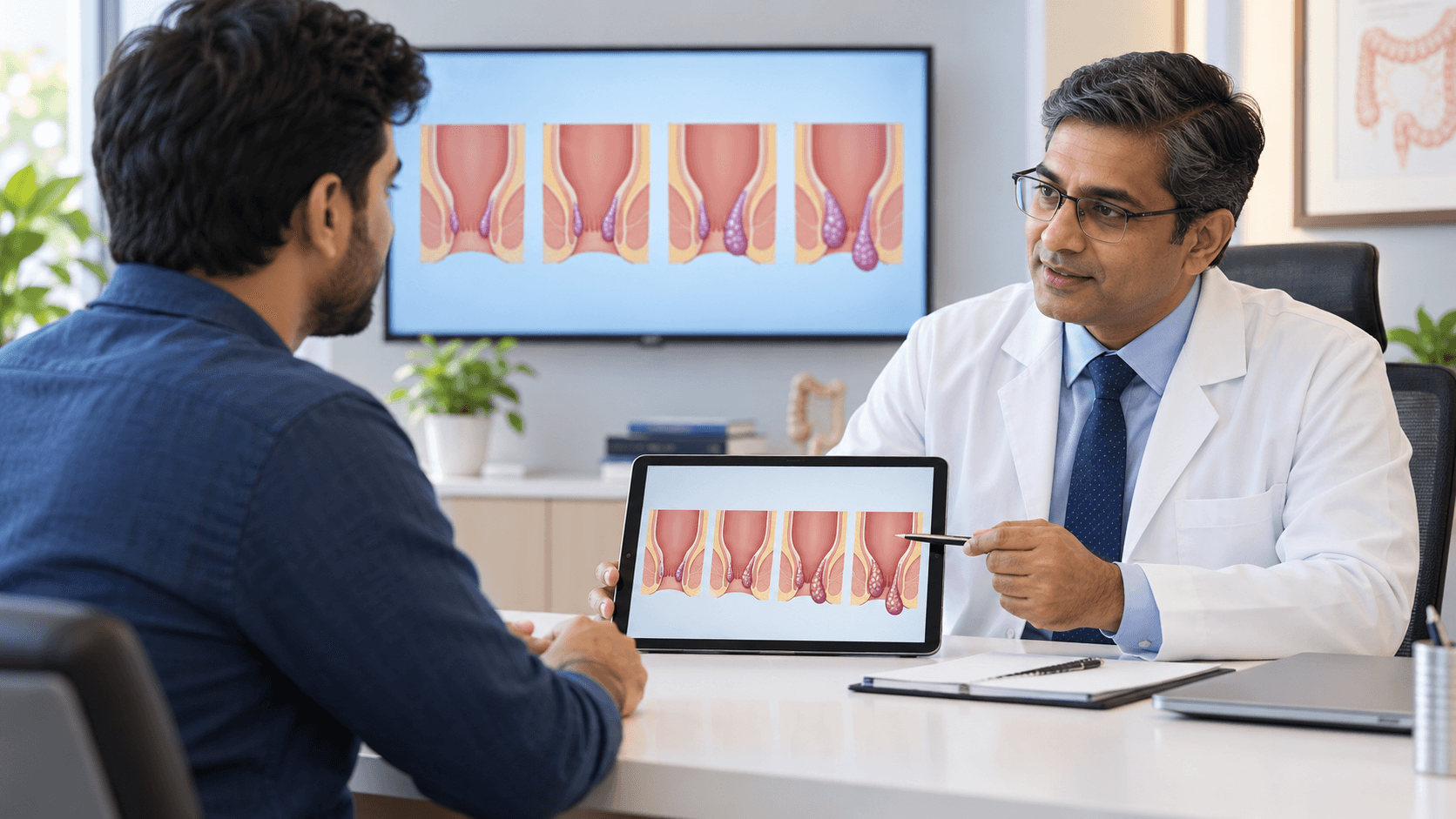
What are the four grades of internal piles?
The four grades describe prolapse. Grade 1 internal piles stay inside the anal canal. Grade 2 piles protrude during straining but return by themselves. Grade 3 piles protrude and usually need to be gently pushed back. Grade 4 piles remain outside and cannot be reduced. This classification does not apply neatly to external piles.
Hemorrhoid grading is a clinical way to describe how internal hemorrhoidal tissue behaves. It is not a complete measure of pain, bleeding or urgency: a lower grade may bleed, while severe pain can come from thrombosis, fissure, abscess or another condition rather than the grade alone.
Fast decision rule: note whether tissue comes out, whether it returns by itself and whether it stays outside—but do not assign your own grade from a photo. Repeated prolapse deserves examination; trapped painful tissue, heavy bleeding, faintness or fever needs urgent medical assessment.
How do grade 1, 2, 3 and 4 piles compare?
Grade 1: tissue remains inside and may cause bright red bleeding or irritation. Grade 2: tissue comes out with stool or straining and returns on its own. Grade 3: tissue comes out and generally needs manual reduction. Grade 4: tissue stays prolapsed and cannot be pushed back. Examination is needed because rectal prolapse and other lumps may look similar.
Practical comparison: no visible prolapse can fit grade 1; a lump that disappears after stool can fit grade 2; a lump that needs reduction can fit grade 3; tissue that remains outside can fit grade 4. These are discussion clues, not a diagnosis or a treatment prescription.
If tissue comes out during stool, read /articles/piles-coming-out-during-stool-bhopal for a prolapse-versus-rectal-prolapse checklist. If bleeding is the main symptom, /articles/blood-in-stool-piles-fissure-bhopal explains why blood should not automatically be blamed on piles.
Does a higher piles grade always mean surgery?
No. A higher grade makes a procedure or surgery discussion more likely, but grade alone does not select treatment. A surgeon also considers bleeding, discomfort, reducibility, thrombosis, anemia, bowel habits, previous treatment, medicines, pregnancy status, general health and what the examination confirms.
NIDDK explains that hemorrhoid care can range from diet and bowel-habit measures to office procedures and surgery. The American Society of Colon and Rectal Surgeons notes that treatment is chosen according to symptoms and the type and extent of hemorrhoids. This is why two people described as grade 3 may not receive the same recommendation.
The easiest next step is diagnosis first: bring a symptom timeline, medicine list and prior reports. /articles/piles-fissure-fistula-treatment-options-bhopal gives a plain-language overview of conservative, procedural and surgical discussions, while /contact provides appointment details for Dr. Rajesh Kanungo at R.K. Hospital, Indrapuri.
Why can piles symptoms and grade seem mismatched?
Piles grade records prolapse, not every symptom. Grade 1 internal piles may bleed without coming outside. A prolapsed pile may feel uncomfortable but not sharply painful. Sudden severe pain may instead reflect a thrombosed external hemorrhoid, trapped prolapse, fissure, abscess or another anorectal problem that needs examination.
External hemorrhoids are below the skin around the anus and are not classified by the same grade 1-to-4 prolapse system. Mixed hemorrhoids can include internal and external components, which is another reason an online stage chart cannot replace inspection and clinical assessment.
If pain during bowel movement is the main problem, use /articles/pain-during-bowel-movement-piles-fissure-bhopal. If there is a new lump with throbbing pain, swelling or fever, /articles/lump-near-anus-piles-abscess-bhopal explains why prompt review matters.
What should you ask during a piles consultation?
Ask what condition is actually causing the symptom, whether the piles are internal, external or mixed, whether prolapse is present, whether bleeding needs further evaluation, and what would make observation, an office procedure or surgery reasonable. Also ask what recovery, recurrence and follow-up may look like for the option being discussed.
Carry details of bleeding colour and amount, pain timing, constipation or diarrhea, whether tissue returns by itself, weight loss or bowel-habit change, prior piles procedures, colonoscopy reports if any, and medicines such as blood thinners. Do not stop prescribed medicines without the clinician who manages them.
A general or colorectal-focused surgeon can distinguish piles from fissure, abscess, fistula, rectal prolapse and other causes. /articles/which-doctor-for-piles-bhopal can help you prepare for a private diagnosis-first appointment in Bhopal.
When do suspected piles need urgent medical care?
Seek urgent assessment for heavy or continuous rectal bleeding, fainting, dizziness, confusion, marked weakness, black or tarry stool, severe or rapidly worsening pain, tissue trapped outside and turning dark, or fever with anal swelling. Call emergency services or go to an emergency department if the patient appears very unwell.
Rectal bleeding should not be self-diagnosed as piles, especially when it is new, recurrent, mixed through stool, associated with abdominal pain, bowel-habit change, weight loss or anemia. NIDDK advises prompt medical help for severe anal pain and bleeding, particularly with abdominal pain, diarrhea or fever.
This page is patient education, not a diagnosis, prescription or emergency triage service. For persistent symptoms, arrange a clinician review. For severe bleeding, faintness, uncontrolled pain, fever or rapidly worsening swelling, use urgent or emergency care instead of waiting for an online answer.
Which medical sources support this guide?
This guide was cross-checked against NIDDK hemorrhoid information at https://www.niddk.nih.gov/health-information/digestive-diseases/hemorrhoids and treatment guidance at https://www.niddk.nih.gov/health-information/digestive-diseases/hemorrhoids/treatment, NHS piles guidance at https://www.nhs.uk/conditions/piles-haemorrhoids/, and American Society of Colon and Rectal Surgeons patient information at https://fascrs.org/patients/diseases-and-conditions/a-z/hemorrhoids-expanded-version.
These sources support the central safety points: internal hemorrhoids may prolapse to different degrees; treatment depends on symptoms and examination, not a stage label alone; and severe pain, significant bleeding, trapped tissue or systemic illness needs prompt medical assessment.
Related care options
More patient guides
Types of Abdominal Hernias: A Location Guide for Bhopal Patients
Abdominal hernias are named mainly by where tissue pushes through a weak area: the groin, upper thigh, navel, upper midline, abdominal wall or an old surgical scar. Location is a useful clue, but examination—not a photo or symptom list—is what separates a hernia from other lumps and guides safe treatment.
Can You Live Without a Gallbladder? What Changes After Surgery
Yes. Most people can live a normal life without a gallbladder because the liver keeps making bile. After removal, bile flows directly into the small intestine instead of being stored. Some people notice temporary digestive changes, but persistent or severe symptoms deserve medical review.
Nail Polish Before Surgery: What Should Patients Remove?
Many hospitals ask patients to remove nail polish, gel or false nails before surgery because staff may need access to a natural nail for monitoring and assessment. The safest shortcut is simple: ask the hospital in advance, follow its written instruction, and tell the team if a product or item cannot be removed safely.
Common questions
Grade 1 stays inside, grade 2 comes out but returns by itself, grade 3 usually needs manual reduction, and grade 4 remains outside and cannot be reduced. Examination is needed to confirm the condition.
Grade 3 does not automatically mean one specific operation. A surgeon considers symptoms, bleeding, prolapse, previous treatment and health history before discussing conservative care, office procedures or surgery.
No. The grade 1-to-4 system describes prolapse of internal hemorrhoids. External hemorrhoids and mixed hemorrhoids are assessed differently.
Grade 4 piles needs medical assessment, but urgency depends on symptoms. Severe pain, dark trapped tissue, heavy bleeding, faintness, fever or a very unwell appearance needs urgent care.
A general or colorectal-focused surgeon can examine suspected piles, distinguish internal from external or mixed disease, assess prolapse and explain appropriate options after confirming the diagnosis.