
What are incisional hernia symptoms after abdominal surgery?
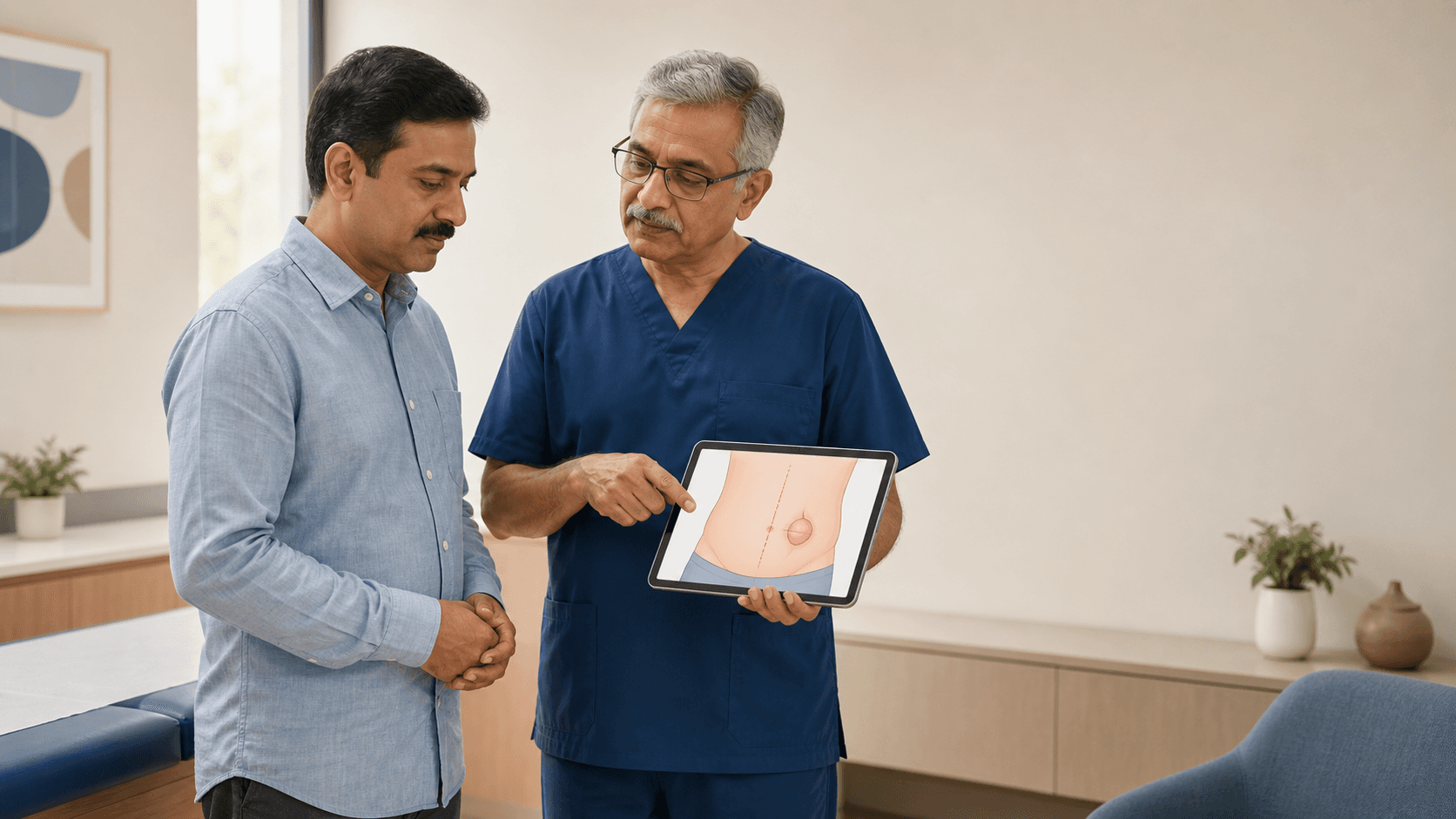
Incisional hernia symptoms commonly include a bulge at or beside an old abdominal surgery scar, heaviness, pulling, pressure or pain that becomes clearer while standing, coughing, lifting or straining. The swelling may flatten while lying down, but a surgeon must examine it because scar swelling has other possible causes.
An incisional hernia is a gap or weakness in the abdominal wall at the site of a previous surgical incision, allowing tissue or bowel to push outward. It may appear months or years after the original operation rather than immediately after wound healing. For a location-based comparison with umbilical, epigastric, inguinal and femoral hernias, read /articles/types-of-abdominal-hernias-bhopal.
Fast decision rule: book a surgical review for a persistent or growing scar-site bulge; contact a doctor sooner for increasing pain or wound changes; go to emergency care for a suddenly painful, hard or stuck bulge with vomiting, abdominal swelling, fever, fainting or skin discoloration.
How can you tell an incisional hernia from normal scar swelling?
An incisional hernia often changes with pressure: it may become more obvious on standing, coughing or straining and less obvious while lying down. Normal early postoperative swelling should generally settle with healing. A fluid collection, infection, scar tissue or another abdominal-wall lump can look similar, so this pattern is a reason for examination, not a home diagnosis.
Comparison checklist: a cough-related bulge raises hernia concern; redness, warmth, fever or discharge raises infection concern; soft swelling soon after surgery may be a fluid collection; a new lump months or years later needs fresh assessment. If the operation was recent, read /articles/laparoscopic-incision-care-bhopal and contact the operating team rather than repeatedly pressing the area.
The Cleveland Clinic explains that incisional hernias usually occur at a prior surgical incision and may cause a visible bulge with discomfort that worsens during lifting or coughing: https://my.clevelandclinic.org/health/diseases/15757-incisional-hernia.
Why does an incisional hernia develop months or years later?
The abdominal wall may remain weaker where it was opened and closed. Hernia risk is influenced by the incision, wound healing, infection, repeated strain, body weight, smoking, diabetes, chronic cough, constipation, earlier operations and the type of original surgery. One symptom cannot identify the cause in an individual patient.
The American College of Surgeons notes that incisional hernias develop at the site of a previous operation and discusses factors such as obesity, smoking and wound infection when explaining ventral hernia care: https://www.facs.org/for-patients/the-day-of-your-surgery/ventral-hernia-repair/.
Do not assume the bulge happened because of one episode of lifting or because the earlier surgery was done incorrectly. Bring the old discharge summary and operation notes if available; they help the surgeon understand the incision, prior repair and current options.
When is a bulge near an old surgery scar an emergency?
A suddenly painful bulge that becomes hard, tender or impossible to reduce can signal trapped tissue. Vomiting, increasing abdominal swelling, inability to pass stool or gas, fever, rapid deterioration, red or dark skin over the lump, fainting or confusion makes emergency assessment more urgent.
MedlinePlus advises urgent medical help for a hernia that cannot be pushed back, becomes tender, or occurs with nausea or vomiting: https://medlineplus.gov/ency/article/000960.htm. The NHS similarly advises emergency care for sudden severe pain, vomiting, difficulty passing stool or gas, or a firm tender hernia: https://www.nhs.uk/conditions/hernia/.
Emergency guidance: do not wait for a routine clinic appointment if severe or rapidly worsening symptoms occur. Go to the nearest emergency department or call local emergency services. Do not force a painful bulge back in. For a focused warning-sign guide, read /articles/strangulated-hernia-symptoms-bhopal. This page is patient education and cannot diagnose or prescribe treatment.
How does a surgeon check a possible incisional hernia?
Assessment usually starts with the operation history and an abdominal examination while lying and standing. The surgeon may ask you to cough or gently strain. Ultrasound or CT may be considered when the bulge is unclear, the defect is large or recurrent, or the surgeon needs more detail for planning.
Bring a short timeline: original operation and date, when the lump appeared, whether it changes with posture or coughing, pain pattern, vomiting or bowel symptoms, previous wound infection, and how lifting affects it. Carry old operation notes, discharge papers and available scan reports.
A scan is not automatically the first or best step for every patient. Read /articles/hernia-ultrasound-vs-ct-scan-bhopal before self-booking imaging; examination helps decide whether imaging is useful and which test can answer the clinical question.
What should you ask about incisional hernia treatment?
The useful consultation is not just “Do I need surgery?” Ask about the defect size and location, whether observation is reasonable, what symptoms should change the plan, open versus laparoscopic repair, whether mesh may be discussed, recurrence risk, anesthesia assessment, recovery time and work-lifting restrictions.
Treatment is individualized. The plan can change with symptoms, defect size, previous repairs, infection history, diabetes, smoking, weight, cough, constipation, other illnesses and anesthesia fitness. Do not start a belt, medicine or exercise programme as a substitute for assessment.
For repair approach questions, compare /articles/open-vs-laparoscopic-hernia-surgery-bhopal and /articles/hernia-mesh-repair-bhopal. Bhopal patients can use /services/hernia-surgery or /contact to arrange an examination with Dr. Rajesh Kanungo at R.K. Hospital, Indrapuri.
Which reliable sources support this patient guide?
This guide was cross-checked against Cleveland Clinic incisional hernia information at https://my.clevelandclinic.org/health/diseases/15757-incisional-hernia, American College of Surgeons ventral hernia patient guidance at https://www.facs.org/for-patients/the-day-of-your-surgery/ventral-hernia-repair/, MedlinePlus hernia guidance at https://medlineplus.gov/ency/article/000960.htm, and NHS hernia guidance at https://www.nhs.uk/conditions/hernia/.
The shared message is conservative: a scar-site bulge needs examination, symptoms alone cannot confirm its cause, scans are selected after clinical assessment, and severe pain with a stuck bulge, vomiting or bowel-obstruction symptoms should receive emergency attention.
Related care options
More patient guides
Types of Abdominal Hernias: A Location Guide for Bhopal Patients
Abdominal hernias are named mainly by where tissue pushes through a weak area: the groin, upper thigh, navel, upper midline, abdominal wall or an old surgical scar. Location is a useful clue, but examination—not a photo or symptom list—is what separates a hernia from other lumps and guides safe treatment.
Can You Live Without a Gallbladder? What Changes After Surgery
Yes. Most people can live a normal life without a gallbladder because the liver keeps making bile. After removal, bile flows directly into the small intestine instead of being stored. Some people notice temporary digestive changes, but persistent or severe symptoms deserve medical review.
Nail Polish Before Surgery: What Should Patients Remove?
Many hospitals ask patients to remove nail polish, gel or false nails before surgery because staff may need access to a natural nail for monitoring and assessment. The safest shortcut is simple: ask the hospital in advance, follow its written instruction, and tell the team if a product or item cannot be removed safely.
Common questions
Yes. An incisional hernia may become noticeable months or years after an abdominal operation. A new or enlarging bulge at an old scar should be examined rather than self-diagnosed.
No. Fluid, infection, scar tissue and other lumps can appear near a surgical scar. A bulge that changes with standing or coughing may raise suspicion, but examination is needed to identify the cause.
Not always. Some hernias are clear on examination. Ultrasound or CT may help when the lump is unclear, large, recurrent or needs detailed repair planning. Let the examining clinician choose the useful test.
Seek emergency care for sudden severe pain, a hard or stuck bulge, repeated vomiting, increasing abdominal swelling, inability to pass stool or gas, fever, fainting, confusion or red, purple or dark skin over the lump.