
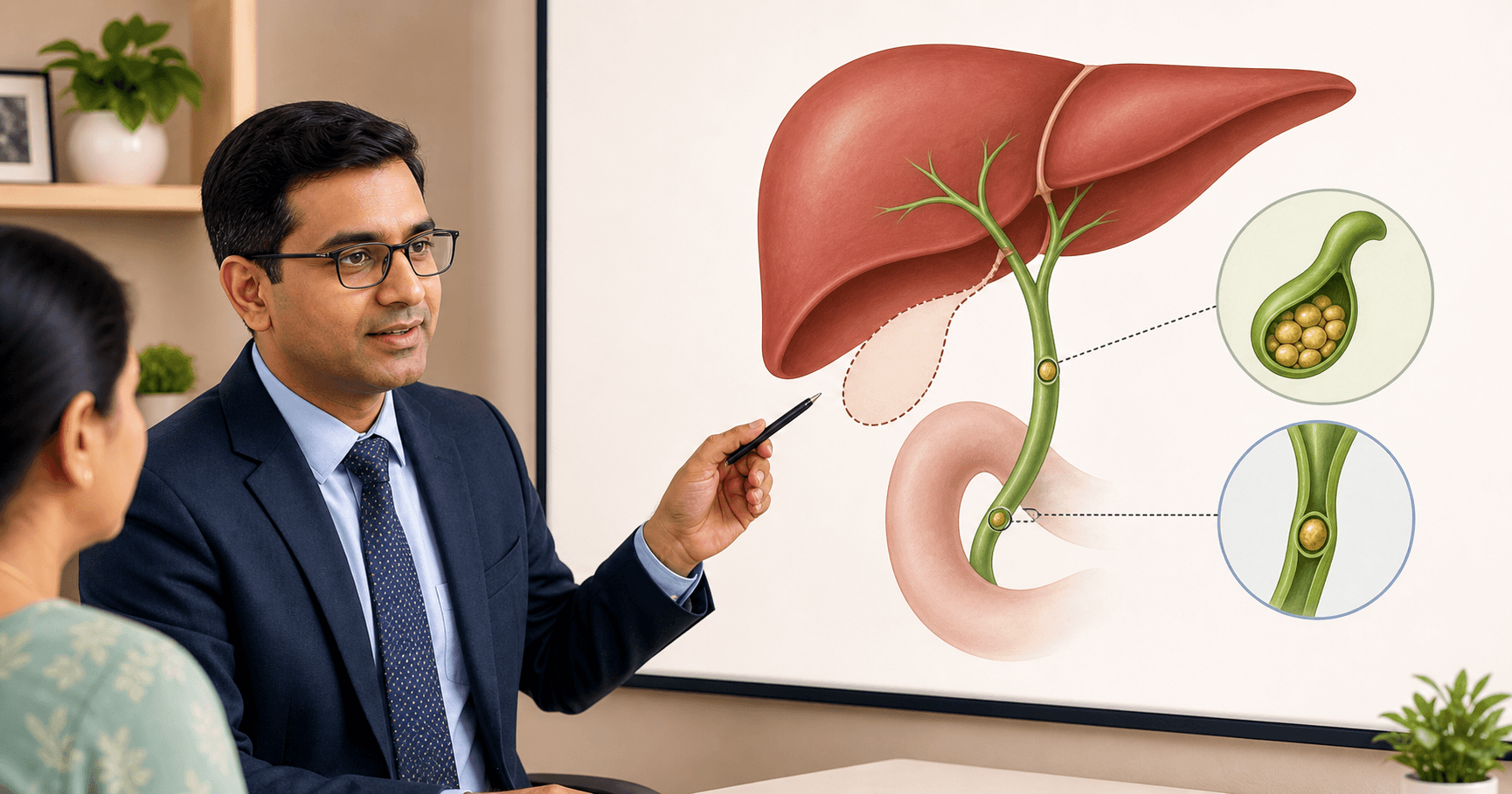
Can gallstones come back after gallbladder removal?
Gallbladder stones cannot come back after the gallbladder itself has been removed. However, a stone may occasionally be found in the common bile duct after surgery. It may have been present but undetected before surgery, or it may rarely form later in the bile duct.
A bile duct stone (choledocholithiasis) is a hardened deposit located in a duct that carries bile from the liver to the intestine. It is different from a stone inside the gallbladder. This distinction explains why someone can have a “stone” after cholecystectomy without having a new gallbladder stone.
Fast decision rule: mild digestive discomfort without warning signs can be discussed at a planned review, but severe or persistent pain, fever, yellow eyes, repeated vomiting or a very unwell feeling needs urgent medical assessment.
Why can a bile duct stone appear after surgery?
A bile duct stone after surgery is usually either retained or recurrent. A retained stone was already in the duct around the time of surgery but was not identified. A recurrent stone forms in the duct later. The timing alone cannot reliably tell which one it is, so doctors use symptoms, blood tests and imaging.
The National Institute of Diabetes and Digestive and Kidney Diseases explains that gallstones can move into and block bile ducts: https://www.niddk.nih.gov/health-information/digestive-diseases/gallstones. Merck Manual notes that bile duct stones can remain after the gallbladder is removed or, less commonly, develop in the ducts later: https://www.merckmanuals.com/home/liver-and-gallbladder-disorders/gallbladder-and-bile-duct-disorders/gallstones.
This is not the most likely explanation for every symptom after surgery. Indigestion, reflux, a stomach or bowel condition, pancreatitis, liver disease, incision problems and other causes can overlap. A symptom review is safer than assuming the gallstones have returned.
Which symptoms need urgent care after gallbladder removal?
Seek urgent care for severe or worsening upper abdominal pain, fever or chills, yellow skin or eyes, dark urine, pale stools, repeated vomiting, fainting, confusion, chest pain, breathing difficulty, or inability to keep fluids down. These signs can occur with bile duct obstruction, infection or another urgent condition.
NIDDK advises prompt medical care when gallstone symptoms include abdominal pain lasting several hours, nausea or vomiting, fever or chills, jaundice, tea-coloured urine or light stools: https://www.niddk.nih.gov/health-information/digestive-diseases/gallstones/symptoms-causes. NHS guidance also treats sudden severe abdominal pain or jaundice as reasons for urgent assessment: https://www.nhs.uk/conditions/gallstones/.
Do not wait for a routine appointment if these warning signs are present. Contact the treating team, go to the nearest emergency department, or use local emergency services. This article cannot determine the cause or urgency of an individual symptom.
How do doctors check for a bile duct stone?
Doctors begin with the pain pattern, surgical history, examination and blood tests, often including liver tests. Ultrasound may show widened bile ducts or a stone. MRCP or endoscopic ultrasound can give a closer view when the first tests do not settle the question. The exact sequence depends on clinical risk.
The American Society for Gastrointestinal Endoscopy uses clinical findings, liver tests and imaging to group patients by likelihood of common bile duct stones and avoid unnecessary invasive procedures: https://www.asge.org/docs/default-source/guidelines/asge-guideline-on-the-role-of-endoscopy-in-the-evaluation-and-management-of-choledocholithiasis-2019.pdf.
Bring the gallbladder surgery discharge summary, operation note if available, previous ultrasound or MRCP reports, current medicine list and a timeline of symptoms. If your surgery was recent, /articles/laparoscopic-gallbladder-surgery-recovery-bhopal explains expected recovery and warning signs.
What may happen if a bile duct stone is confirmed?
A confirmed bile duct stone is commonly removed with ERCP, an endoscopic procedure that reaches the bile duct through the mouth and intestine. Some situations need another endoscopic attempt, radiology support or surgery. The appropriate plan depends on stone location, infection, anatomy and the patient’s overall condition.
ERCP is not a home treatment or a procedure everyone with discomfort needs. It has benefits and risks, including pancreatitis, bleeding, infection and perforation, so the treating gastroenterologist or surgeon decides when the expected benefit justifies it. NIDDK describes ERCP as a method used to remove a stone stuck in the common bile duct: https://www.niddk.nih.gov/health-information/digestive-diseases/gallstones/treatment.
Do not start antibiotics, pain medicines, “stone dissolving” remedies or restrictive diets based only on an online article. Discuss symptom relief and any medicine changes with a clinician who knows your surgery and medical history.
How can you tell routine recovery from a possible duct problem?
Routine recovery often improves gradually, while a possible duct problem deserves review when symptoms are new, persistent, worsening or paired with fever, jaundice, dark urine, pale stools or repeated vomiting. No checklist can diagnose the cause, but the pattern helps determine how quickly to seek care.
Decision guide: improving incision soreness or temporary bloating without red flags usually fits planned follow-up; recurring upper abdominal attacks need a doctor appointment; jaundice, fever or persistent severe pain needs urgent assessment; chest pain, breathing difficulty, collapse or confusion needs emergency care.
For food-related recovery questions, see /articles/what-to-eat-after-gallbladder-surgery-bhopal. For a focused check of improving versus concerning postoperative discomfort, read /articles/soreness-after-gallbladder-removal-bhopal. If pain is present but surgery has not occurred, /articles/gallbladder-pain-vs-acidity-bhopal explains why symptom location alone cannot confirm gallstones.
What is the safest next step for patients in Bhopal?
The safest next step is to match the urgency to the symptoms: emergency evaluation for warning signs, or a planned surgical review for stable recurring symptoms. Bring previous reports instead of repeating tests independently, and write down when the symptoms began and what accompanies them.
Patients in Bhopal can consult Dr. Rajesh Kanungo at R.K. Hospital, Indrapuri, for a post-cholecystectomy surgical assessment. The purpose of consultation is to evaluate the cause, not to assume that another stone is present or that a procedure is required.
For service information, visit /services/gallbladder-stone-surgery or /services/laparoscopic-surgery. To arrange a review and confirm what reports to carry, use /contact.
Which medical sources support this guide?
This patient-education guide was cross-checked against NIDDK information on gallstone symptoms, causes and treatment; NHS gallstones guidance; the Merck Manual overview of gallstones and bile duct stones; and the ASGE guideline on evaluating and managing choledocholithiasis. Source links are included in the relevant sections above.
This article is not a diagnosis, prescription, personalized surgical recommendation or replacement for examination. Symptoms after gallbladder removal have several possible causes. A clinician must interpret them alongside examination, blood tests, imaging and the original surgery details.
Related care options
More patient guides
Types of Abdominal Hernias: A Location Guide for Bhopal Patients
Abdominal hernias are named mainly by where tissue pushes through a weak area: the groin, upper thigh, navel, upper midline, abdominal wall or an old surgical scar. Location is a useful clue, but examination—not a photo or symptom list—is what separates a hernia from other lumps and guides safe treatment.
Can You Live Without a Gallbladder? What Changes After Surgery
Yes. Most people can live a normal life without a gallbladder because the liver keeps making bile. After removal, bile flows directly into the small intestine instead of being stored. Some people notice temporary digestive changes, but persistent or severe symptoms deserve medical review.
Nail Polish Before Surgery: What Should Patients Remove?
Many hospitals ask patients to remove nail polish, gel or false nails before surgery because staff may need access to a natural nail for monitoring and assessment. The safest shortcut is simple: ask the hospital in advance, follow its written instruction, and tell the team if a product or item cannot be removed safely.
Common questions
You cannot develop a new stone inside a gallbladder that has been removed. A stone can occasionally remain in or later form inside a bile duct, which needs medical assessment rather than self-diagnosis.
A retained stone may be detected relatively soon, while a recurrent bile duct stone may appear later. Timing cannot confirm the cause; symptoms, liver tests and imaging are used to investigate.
Severe or persistent upper abdominal pain, fever or chills, yellow eyes, dark urine, pale stools and repeated vomiting need urgent medical assessment because they may indicate obstruction, infection or another serious condition.
No. Recovery discomfort and several digestive, liver, pancreatic, incision and other conditions can cause pain. New, persistent or worsening pain should be assessed instead of being attributed to stones without testing.